Micro-ROS and XRCE-DDS: How ROS2 Fits into Microcontrollers
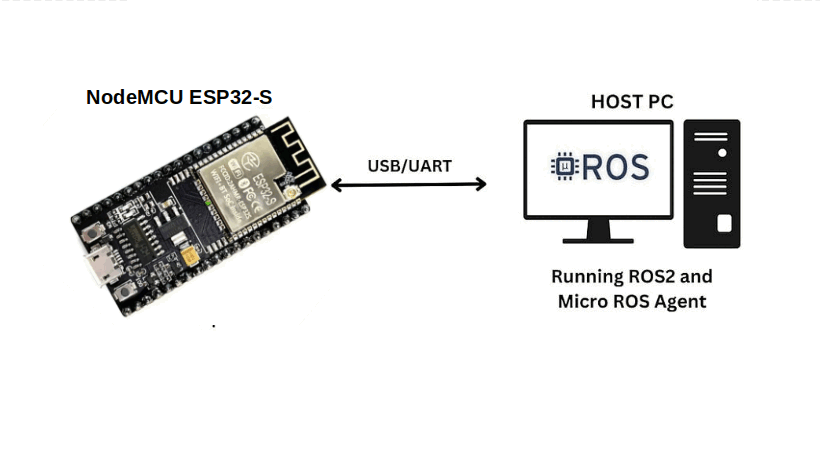
While working on a robotics project recently, I ran into a classic problem: how do you use a comparatively heavy software stack like ROS2 on a microcontroller?
If you've built robots before, you know the struggle. You want the advanced navigation, path planning, and ecosystem of ROS2 running on your host PC or SBC (like a Raspberry Pi), but you also need microcontrollers (like the ESP32 or STM32) for low-latency tasks like motor control, sensor readings, and real-time execution.
That's where I discovered micro-ROS. But as I dug deeper, I realized the transition from standard ROS2 to microcontroller-friendly ROS2 isn't simple. It requires a complete rethink of how nodes talk to each other.
Here is what I learned about why standard ROS2 can't run on an ESP32, and how a protocol called Micro XRCE-DDS solves it.
The Roadblock: Why ROS2 is Too Heavy for Microcontrollers
To understand the problem, we have to look under the hood of standard ROS2.
Unlike ROS1, which relied on a central master node (roscore) for discovery, ROS2 is completely decentralized. It achieves this using a standard called DDS (Data Distribution Service). When ROS2 boots up, nodes use DDS implementations (like FastDDS or CycloneDDS) to dynamically discover other nodes, topics, services, and actions on the network.
This discovery process uses peer-to-peer multicast communication (Simple Discovery Protocol). Every node maintains its own state of the entire network.
On a laptop, PC, or single-board computer, this discovery and communication overhead is negligible. But on a microcontroller like an ESP32 or an Arduino:
- RAM constraints: Microcontrollers usually have less than 512KB of RAM. Keeping a map of the entire DDS network in memory will instantly cause an out-of-memory crash.
- CPU limitations: Processing complex XML/DDS discovery packets in real time hogs the CPU, leaving no room for actual real-time motor control loops.
Standard DDS is simply too bloated for eXtremely Resource Constrained Environments.
The Solution: XRCE-DDS to the Rescue
Seeing this restriction, the community asked: What if we create a DDS-like service designed specifically for extremely low memory usage?
The answer is Micro XRCE-DDS (eXtremely Resource Constrained Environments DDS).
Instead of forcing the microcontroller to run a full peer-to-peer DDS state machine, XRCE-DDS splits the work using a Client-Agent architecture:
- The Client (Microcontroller): Runs a lightweight micro-ROS library. It doesn't run discovery, it doesn't keep track of the network, and it doesn't speak standard DDS. It only knows how to serialize/deserialize data and send it.
- The Agent (Host PC/SBC): A much more powerful machine that sits on the standard ROS2 network. It acts as a proxy or "translator" for the client.
┌────────────────────────┐             ┌────────────────────────┐
│     Microcontroller    │   UDP/      │        Host PC         │
│  ┌──────────────────┐  │   Serial    │  ┌──────────────────┐  │
│  │ micro-ROS Client │◄─┼────────────►│  │  micro-ROS Agent │  │
│  └──────────────────┘  │  (XRCE-DDS) │  └────────┬─────────┘  │
└────────────────────────┘             └───────────┼────────────┘
                                                   │ (Standard DDS)
                                                   ▼
                                        🌍 Standard ROS2 Network
The Catch: Translation & Transport
Because the Client is so lightweight, it has a couple of quirks:
- It doesn't discover on its own: The microcontroller cannot scan the network to find other nodes. It must establish a direct connection to a known Micro-ROS Agent.
- It doesn't speak standard DDS: It uses the XRCE-DDS protocol, which is highly optimized, compact, and designed to transmit data over simple transport layers like UDP, TCP, or even raw Serial (UART).
Because XRCE-DDS and standard DDS speak different languages, the micro-ROS Agent sits on the host PC (running natively or inside a Docker container).
When the microcontroller wants to publish to a topic (e.g., /sensor_data):
- The micro-ROS Client sends a tiny XRCE-DDS message over UDP or Serial to the Agent.
- The Agent receives the message, translates it into a standard DDS payload, and publishes it to the main ROS2 network.
- To the rest of the ROS2 nodes, the microcontroller looks like a standard first-class ROS2 node!
Final Thoughts
Micro-ROS and XRCE-DDS are brilliant compromises. By offloading the heavy memory and discovery requirements of DDS onto a host proxy (the Agent) and leaving the microcontroller to do only serialization, we get the best of both worlds: the full modularity and tooling of ROS2, combined with the low-cost, real-time control of microcontrollers.
If you're building a robot with an ESP32 and want to keep it in the ROS2 ecosystem, setting up a micro-ROS UDP/Serial agent is the way to go.